
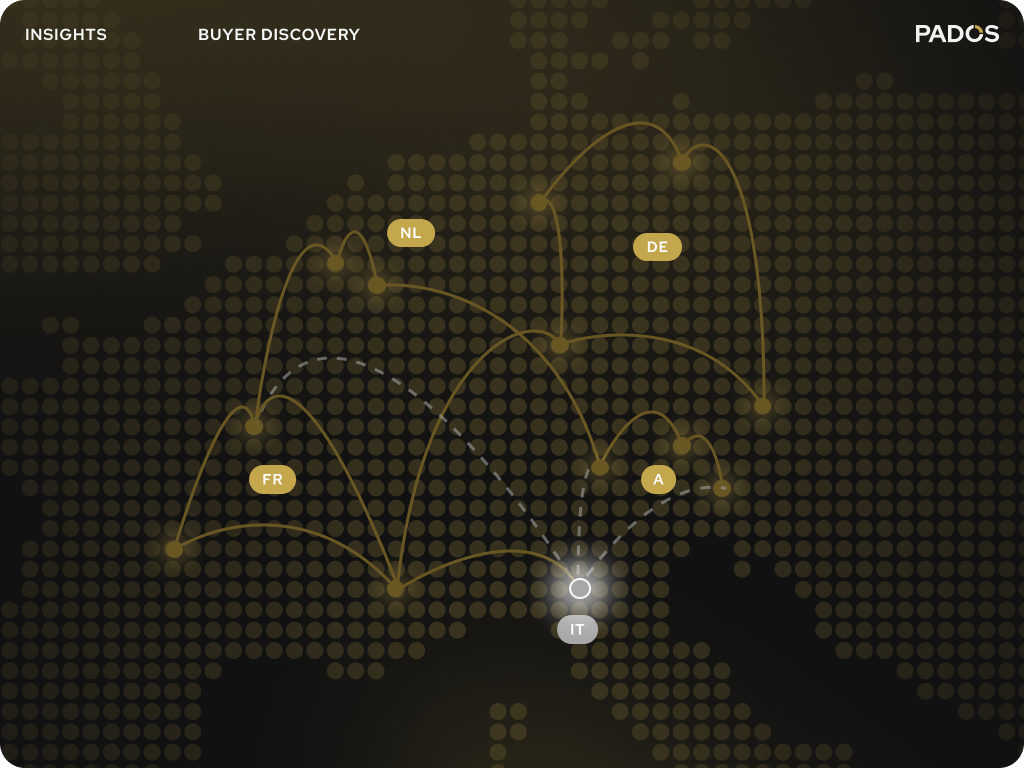
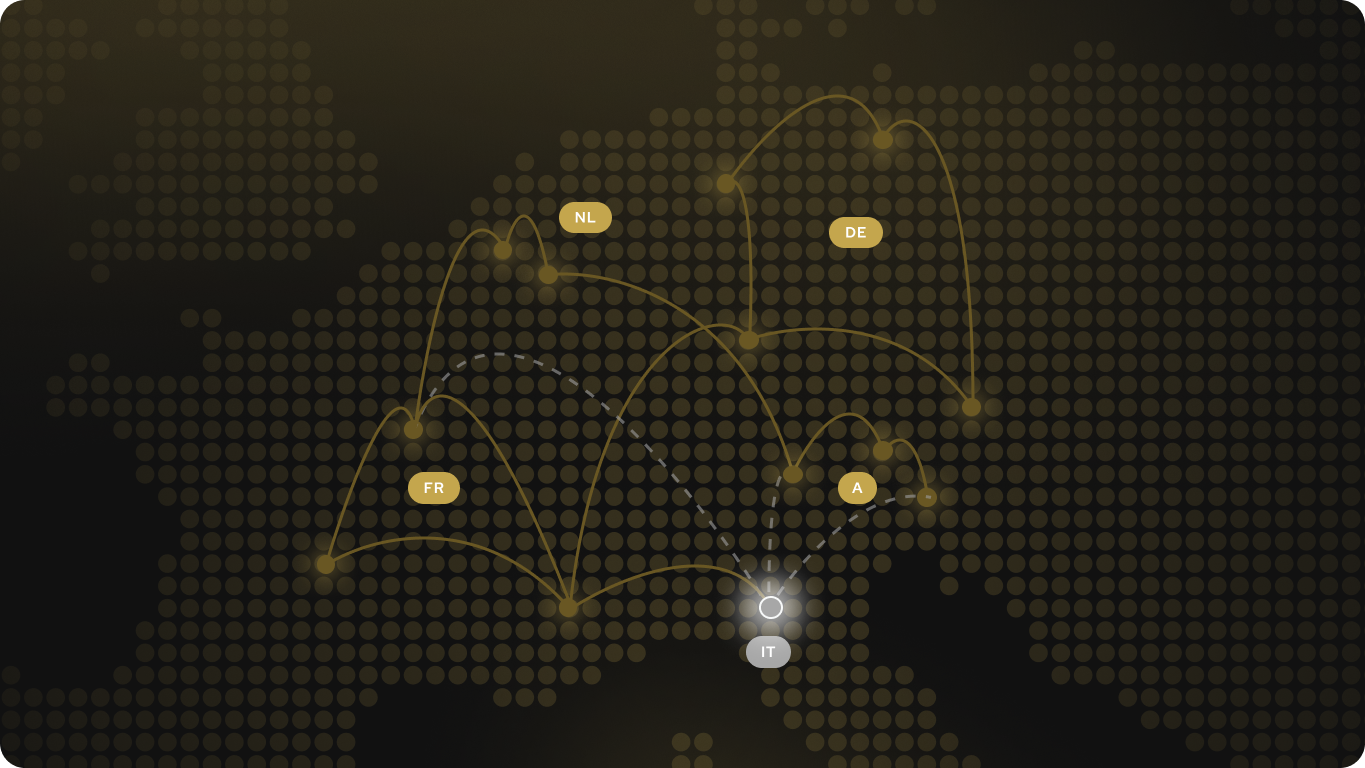
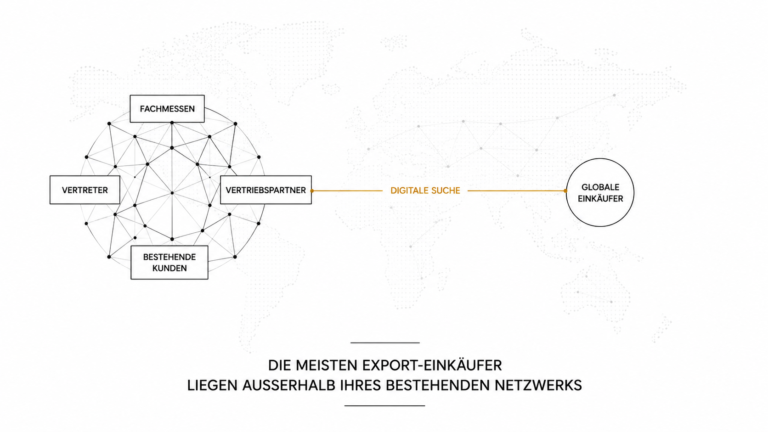
Wenn Ihr Unternehmen exportiert — und im Spezialmaschinen-Bau gilt das für die große Mehrheit der Hersteller — dann sind die meisten Ihrer potenziellen Kunden mit Ihren aktuellen kommerziellen Werkzeugen nicht erreichbar.
Sie sind nicht auf Ihren Mailinglisten. Sie kommen nicht zu Ihren Messen. Sie haben keinen lokalen Agenten, der sie zu Ihnen führt. Sie suchen online, auf Englisch, manchmal in anderen Sprachen, und entscheiden selbst, an wen sie eine Anfrage senden.
Der Ausgangspunkt: Ein stark exportorientierter Sektor
Im Spezialmaschinen-Bau ist die Exportorientierung keine Ausnahme — es ist eine strukturelle Norm. In vielen Subsektoren werden mehr als 70% der Produktion außerhalb des Herstellerlandes verkauft. Hauptzielmärkte umfassen Ost- und Südostasien, Lateinamerika, Osteuropa, Naher Osten, Nordafrika.
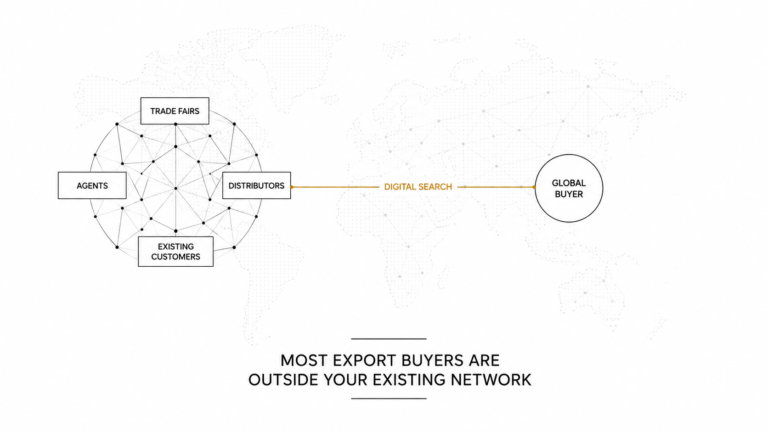
Das produziert eine direkte Beobachtung: Die meisten potenziellen Kunden eines Herstellers von industriellen Spezialmaschinen befinden sich in Ländern, in denen das Unternehmen kein strukturiertes Handelsnetz, keinen dedizierten Agenten hat und nicht an lokalen Referenzmessen teilnimmt.
Der einzige Kanal, der diese Käufer ohne Vermittler erreicht, ist die Website.
Wie internationale Käufer suchen
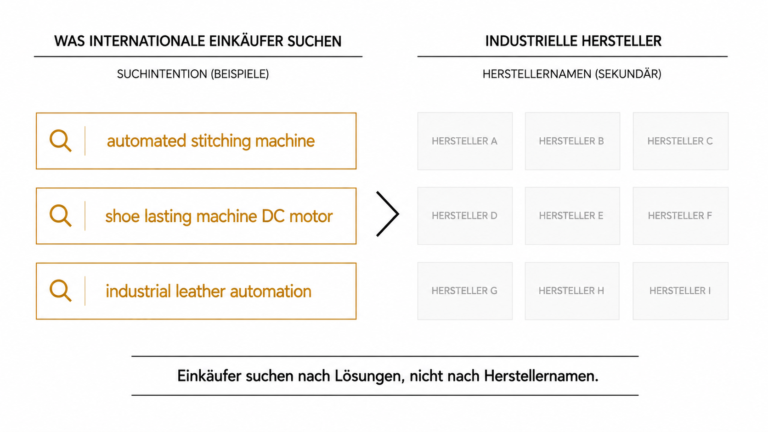
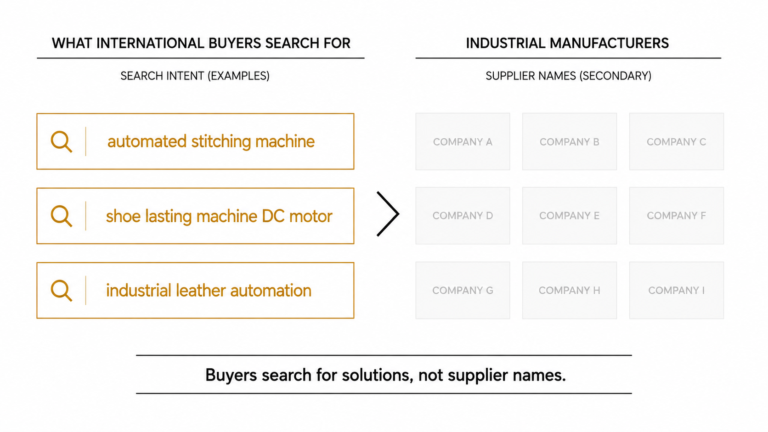
Ein Einkaufsleiter einer neuen Anlage sucht nach der Lösung für ein spezifisches Produktionsproblem — nicht nach dem Namen eines Herstellers, den er noch nie gehört hat. Ein Systemintegrator, der einem Kunden eine Lösung vorschlägt, sucht nach Prozess und technischem Parameter, nicht nach Marke.
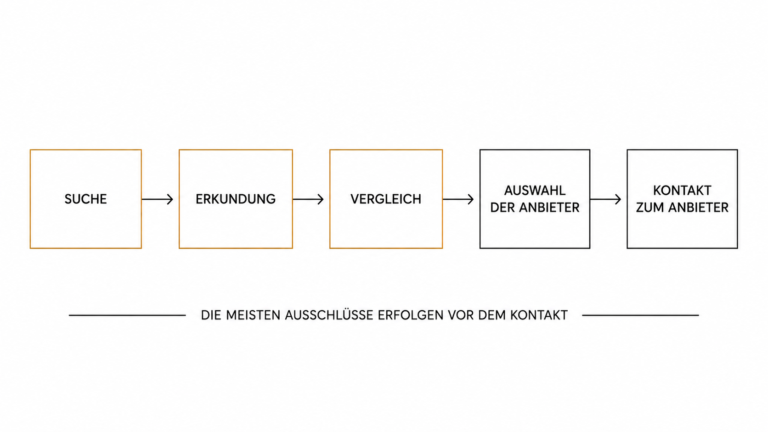
Diese Käufer nutzen Suchmaschinen, internationale B2B-Marktplätze und Messewebsites, um potenzielle Lieferanten zu identifizieren. Und sie treffen Shortlist-Entscheidungen — wen kontaktieren und wen nicht — ausschließlich auf Basis dessen, was sie in dieser Erkundungsphase finden.
Das Muster ist im internationalen industriellen Beschaffungswesen etabliert: Digitale Suche geht dem Kontakt voraus, und die Ausgrenzung aus der Shortlist findet statt, bevor der Lieferant weiß, dass er bewertet wurde.
Was wir im internationalen Sample gefunden haben
Die Analyse umfasste italienische, europäische, brasilianische, taiwanesische und chinesische Hersteller.
Italienische Hersteller haben technisch vollständige Websites. Aber die Struktur ist die eines Katalogs für Brancheninsider. Die Informationen setzen voraus, dass der Besucher die Sektornomenklatur bereits kennt.
Nicht-italienische europäische Hersteller zeigen ein ähnliches Muster, mit einigen Ausnahmen: Bestimmte strukturierte Gruppen veröffentlichen explizit internationale Büros, regionale Kontakte, Händlernetzwerke. Das macht sie sofort zugänglicher für einen ausländischen Käufer.
Brasilianische und asiatische Hersteller haben oft technisch einfachere Websites, aber mit größerer Aufmerksamkeit für ihre internationalen Referenzmärkte — sie erklären explizit die Länder, in denen sie tätig sind, die Messen, an denen sie teilnehmen.
Der bedeutsamste Befund: Fast vollständige Abwesenheit von Beschaffungsinformationen: Richtpreise, Lieferzeiten, Verfügbarkeit lokaler Services, Kaufprozesse für spezifische Märkte. Im gesamten Sample ist “Preis auf Anfrage” die Norm.
Die Informationsasymmetrie, die denjenigen begünstigt, der sie reduziert
In einem Markt, in dem fast niemand strukturierte Informationen für den internationalen Käufer veröffentlicht, heben sich die wenigen, die es tun, per Default hervor.
Es geht nicht darum, die beste Website oder das höchste SEO-Ranking zu haben. Es geht darum, die Fragen zu beantworten, die ein ausländischer Käufer stellt, wenn er einen unbekannten Lieferanten bewertet:
- Ist dieser Hersteller in meinem Markt tätig, oder muss ich direkt importieren?
- Gibt es lokalen technischen Service, oder verwalte ich alles aus Europa?
- Kann ich verstehen, ob das Produkt zu meiner Anwendung passt, ohne eine Beratung anzufordern?
- Ist die technische Dokumentation in einer Sprache verfügbar, mit der ich arbeiten kann?
Unternehmen, die diese Fragen beantworten — mit Seiten nach geografischem Markt, mehrsprachiger Dokumentation, veröffentlichten Servicenetzwerken, vergleichbaren technischen Spezifikationen — bauen einen direkten Vorteil in der Auswahlphase auf.
Wer den Buyer Journey seines Sektors zuerst kennt, hat einen unfairen Vorteil gegenüber allen Wettbewerbern
Es gibt eine abschließende Beobachtung, die aus der Analyse hervorgeht und die es wert ist, explizit gemacht zu werden.
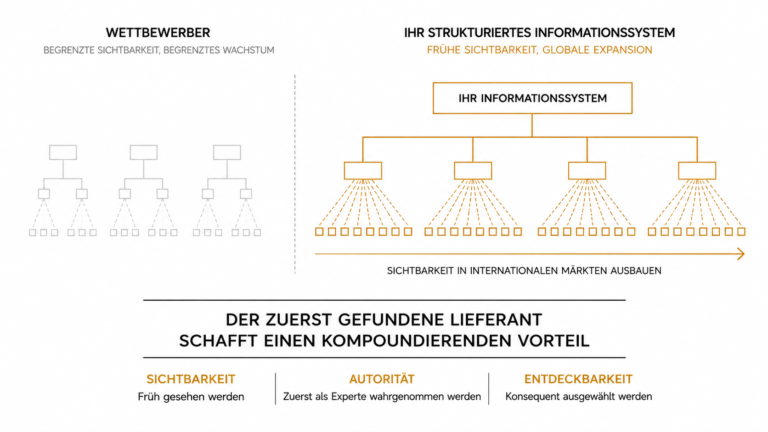
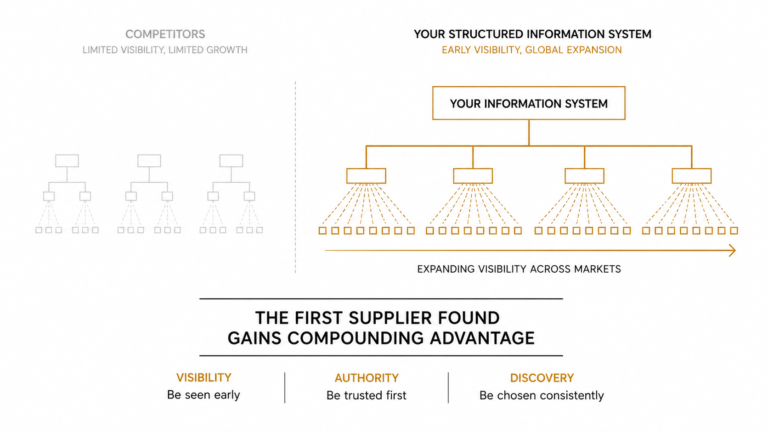
In einem Markt, in dem fast niemand kartiert hat, wie seine Käufer suchen, vergleichen und entscheiden, gewinnt derjenige, der es zuerst tut, einen unverhältnismäßigen Vorteil im Verhältnis zum Aufwand.
Das ist kein technologischer Vorteil, der enorme Investitionen erfordert. Es ist kein Produktvorteil, der Jahre an F&E erfordert. Es ist das Wissen über etwas, das Wettbewerber nicht wissen: den realen Weg, den ein Käufer geht, bevor er einen Lieferanten in dem spezifischen Sektor kontaktiert.
Diese Art von Wissen ist aus zwei Gründen schwer zu kopieren. Erstens braucht es Zeit, sich anzusammeln — echte Daten, echte Sitzungen, echtes Verhalten. Zweitens erzeugt es, einmal in Informationsstruktur übersetzt, kumulative Effekte: Je mehr eine Website die echten Fragen der Käufer beantwortet, desto mehr wird sie gefunden, desto mehr Autorität akkumuliert sie, desto schwerer ist sie für diejenigen zu überholen, die später starten.
Im analysierten Sektor, wo die große Mehrheit der Hersteller diese Arbeit noch nicht getan hat, beginnt derjenige, der heute anfängt, mit einem Marktvorteil, der sich im Laufe der Zeit festigt — nicht weil er mehr Ressourcen hat, sondern weil er zuerst verstanden hat, wie sein Käufer sucht und entscheidet.
Finden Sie heraus, ob Ihre Situation dieselben Lücken hat →
Kostenlose Bewertung. Dreißig Minuten. Keine Verpflichtung.
Analyse durchgeführt an einem internationalen Sample von Herstellern industrieller Spezialmaschinen. Abgedeckte Länder: Italien, Mitteleuropa, Lateinamerika, Ost- und Südostasien. Quellen: Unternehmenswebsites, Exportdaten, Handelsregister, Messeprofile. Unternehmen werden nicht einzeln genannt.
If your company exports — and in Italian specialised industrial machinery this applies to the large majority of manufacturers — then most of your potential customers are not reachable with your current commercial tools.
They are not on your mailing lists.
They do not come to your trade shows.
They do not have a local agent pointing them your way.
They search online, in English and sometimes in other languages, and decide independently who to send an enquiry to.
This is the premise of the research we conducted on an international sample of sector manufacturers.
The Starting Point: A Strongly Export-Oriented Sector
In Italian specialised manufacturing, export orientation is not an exception — it is a structural norm.
In many specialised industrial machinery subsectors, more than 70% of production is sold outside Italy.
Main destination markets include:
- East and Southeast Asia
- Latin America
- Eastern Europe
- the Middle East
- North Africa
Read alongside the sample structure analysed, this produces a direct observation:
most potential customers of an Italian specialised machinery manufacturer are located in countries where the company has:
- no structured commercial network
- no dedicated local agent
- no presence at local reference trade fairs
The only channel capable of reaching these buyers without an intermediary is the website — and specifically its ability to be found when that buyer begins their search.
How International Buyers Search
The research allowed us to reconstruct the typical procurement process of international buyers in this type of market.
It is not a linear process — it is hybrid, and the digital phase comes first.
A procurement manager at a new facility in Vietnam searches for the solution to a specific production problem — not the name of an Italian company they have never heard of.
A system integrator in Brazil proposing a solution to a client searches by:
- process
- technical parameter
- application fit
— not by brand.
These buyers use:
- search engines
- international B2B marketplaces
- trade fair websites
to identify potential suppliers.
They make shortlisting decisions — who to contact and who not to — based exclusively on what they find during this exploration phase.
The pattern is now established in international industrial procurement:
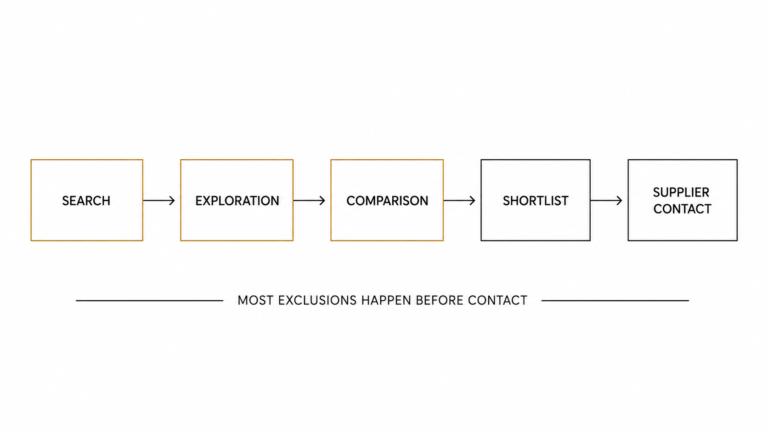
digital search precedes contact, and exclusion from the shortlist happens before the supplier knows they were being evaluated.
What We Found in the International Sample
The analysis covered Italian, European, Brazilian, Taiwanese and Chinese manufacturers.
The geographic comparison is revealing.
Italian manufacturers
Italian manufacturers generally have technically complete websites:
- products
- technical specifications
- references
But the structure is typically that of a catalogue designed for industry insiders.
The information assumes the visitor:
- already knows the sector terminology
- already knows what to look for
There are usually:
- no selection guides
- no navigation by application
- no logic by production problem
European manufacturers outside Italy
Many non-Italian European manufacturers show a similar pattern, with some notable exceptions.
Certain structured groups explicitly publish:
- international offices
- regional contacts
- distributor networks
This immediately makes them more accessible to foreign buyers evaluating whether local support exists.
Brazilian and Asian manufacturers
Brazilian and Asian manufacturers often have technically simpler websites, but show greater attention to international discoverability.
They more frequently publish:
- countries served
- trade fairs attended
- regional contact channels
- market-specific references
This likely reflects greater dependence on the digital channel as an acquisition tool, especially where established commercial networks in Europe do not exist.
The most significant finding
The most significant finding across the entire sample is the near-total absence of procurement information.
Buyers rarely find:
- indicative pricing
- delivery expectations
- local service availability
- purchasing information by market
Across almost the entire sample, “price on request” is the norm.
This is understandable for configured industrial products.
But the side effect is important:
buyers cannot determine whether a supplier fits their budget before initiating contact.
This increases friction and reduces qualified enquiries.
The Information Asymmetry That Favours Whoever Reduces It
The clearest result of the analysis is this:
in a market where almost no one publishes information structured for the international buyer, the few who do stand out automatically.
This is not about:
- having the best website
- having the largest marketing budget
- ranking highest on Google
It is about answering the questions a foreign buyer asks when evaluating an unknown supplier:
- Does this manufacturer operate in my market, or do I need to import directly?
- Is there local technical service, or do I manage everything from Europe?
- Can I understand whether the product suits my application without requesting a consultation?
- Is documentation available in a language I can work with?
Companies that answer these questions build a direct advantage in the selection phase.
This can include:
- pages organised by geographic market
- multilingual documentation
- published service networks
- comparable technical specifications
Not because of marketing budget.
But because they reduce friction in the evaluation process.
Knowing Your Sector’s Buyer Journey First Gives You an Unfair Advantage Over Every Competitor
There is a final observation that emerges from the analysis and is worth making explicit.
In a market where almost no one has mapped how buyers search, compare and decide, the first company that does gains a disproportionate advantage relative to the effort involved.
This is not:
- a technological advantage requiring enormous investment
- a product advantage requiring years of R&D
- a matter of having more resources
It is knowing something competitors do not know:
the real path a buyer takes before contacting a supplier in that specific sector.
This type of knowledge is difficult to replicate for two reasons.
First, it takes time to accumulate:
- real data
- real sessions
- real behaviour
Second, once translated into information structure, it produces cumulative effects.
The more a site answers buyers’ real questions:
- the more it gets found
- the more authority it accumulates
- the harder it becomes to overtake for those who start later
In the sector analysed, where the vast majority of manufacturers have not yet done this work, whoever starts today enters the market with an advantage that consolidates over time — not because they have more resources, but because they understood first how their buyer searches and decides.
The Market Window for Those Who Move Now
The global market for specialised industrial machinery is in structural growth.
This growth is driven by:
- industrial automation
- process optimisation
- manufacturing expansion in Asia, Latin America and Africa
More than 45% of factories in the most dynamic sectors have already adopted automated systems.
And this percentage is expected to continue rising.
This means that in the coming years there will be facilities making their first automated machinery purchase.
These buyers:
- have no existing supplier relationships
- have no established commercial network
- will necessarily begin their search online
The manufacturer found during that search gains an advantage that is extremely difficult to recover later.
Structuring product information to be found by this type of buyer is not only a long-term investment.
It is an investment capable of producing measurable results within weeks, as concrete case data we documented shows.
Find Out Whether Your Situation Has the Same Gaps
The free PADOS assessment analyses:
- how international buyers discover your products
- where friction appears in the evaluation process
- which information is preventing buyers from moving forward
Thirty minutes. No commitment. You receive the feedback regardless.
Analysis conducted on an international sample of specialised industrial machinery manufacturers. Countries covered: Italy, Central Europe, Latin America, East and Southeast Asia. Sources: company websites, export data, company registries and trade fair profiles. Companies are not named individually.