
The Sector That Doesn’t Get Found: How Specialised Industrial Machinery Loses Buyers Before the First Contact

We analysed an entire sector of specialised industrial machinery manufacturers — Italian companies, European competitors, and producers from other continents. Same product category. Same potential buyers. Overlapping markets.
The finding is consistent across all geographies: almost none of them organise their product information the way a buyer searches today.
This article is not a critique of individual manufacturers. It is a portrait of a structural pattern — and an explanation of why it exists.
How an Industrial Buyer Actually Searches Today
Before analysing the websites, it is worth describing precisely what a buyer does when evaluating machines or technical solutions for a production process.
Because the gap between this behaviour and the way manufacturers present themselves online is the root of the problem.
When a company needs a machine, the process does not start with a supplier. It starts with a problem.
A process engineer, a plant manager or a procurement team begins by trying to understand which solutions exist, which technologies are suitable, which suppliers are capable. All of this happens independently, before any contact.
In most B2B sectors, buyers complete a significant part of their evaluation before contacting suppliers — often more than 50–70% of the process.
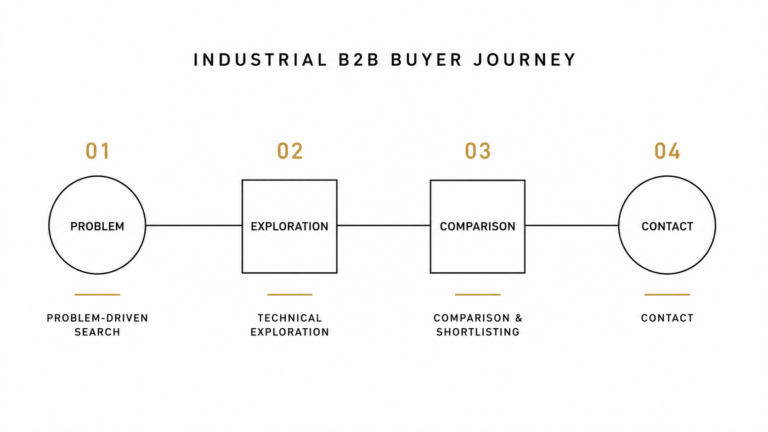
Step 1 — Problem-driven search
The buyer searches by application, by production process, by required performance. Not by company name or product code.
They are looking for the solution to a specific technical problem.
Step 2 — Technical exploration
Once possible solutions emerge, the buyer looks for technical specifications, operating ranges, compatibility with their process, real use cases.
At this stage, multiple suppliers are evaluated in parallel — without contacting anyone.
Step 3 — Comparison and shortlisting
The buyer narrows down to a small number of suppliers.
This happens based on:
- clarity of available information
- ability to compare solutions
- perceived fit
Step 4 — Contact
Only after this process does the buyer send an enquiry, request a quotation, or initiate a conversation.
By this point, most decisions are already oriented.
The direct implication:
If a supplier is not visible and understandable during the first three steps, they are excluded before the first contact — without knowing it.
This is not a digital abstraction.
It is the path your customers already take — with or without your company being visible in that process.
The Context: A Global, Fragmented, Export-Driven Market
The sector analysed is composed of many specialised producers, each focused on specific production phases. This fragmentation increases complexity for buyers, who must navigate multiple suppliers without clear reference points.
Italian companies hold a strong position: technical quality, process know-how, customisation capability. They are structurally export-oriented — often more than 70% of production is sold abroad.
The typical buyer is not local.
They are often in Asia, Latin America or Eastern Europe. They do not know the suppliers. They may not have a local agent. They may not attend trade fairs.
They start their search online — not as a preference, but as a necessity in a fragmented global supply landscape.
Why Manufacturers Focused on Other Channels — and Why That Was the Right Choice
This is not a story of mistakes.
It is a story of rational adaptation to a different market context.
For decades, trade fairs were often the only effective way to meet new buyers. Companies invested heavily in them because they worked:
- machines could be seen in operation
- trust could be built directly
- relationships could be established
At the same time:
- local agents and distributors covered markets geographically
- installed base generated repeat business
In this system, the website had a clear role:
It was a catalogue — not a discovery tool.
These choices were coherent with the context.
The problem is not the past. It is that the entry point of the buyer has changed.
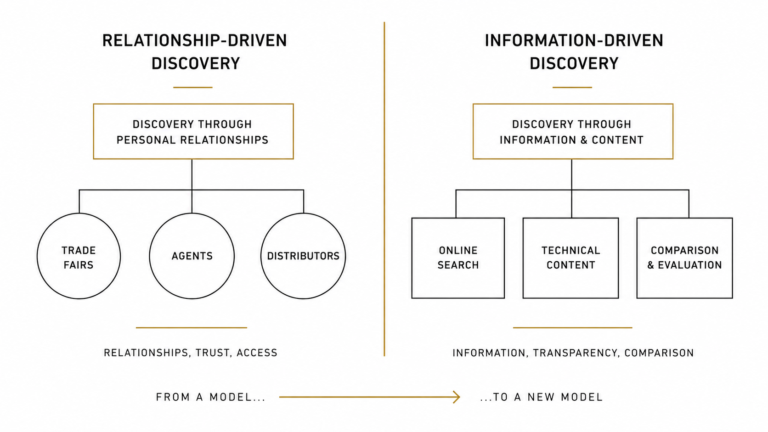
The shift is not from physical to digital.
It is from relationship-driven discovery to information-driven discovery.
What the Analysis Reveals
The analysis covered manufacturers from Italy, Europe, Brazil, Taiwan and China. The pattern is consistent across all regions.
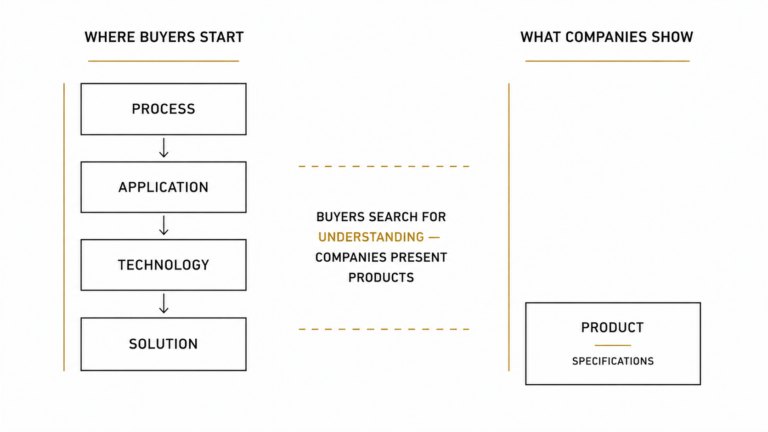
1. Websites start from the wrong level
The mismatch is simple:
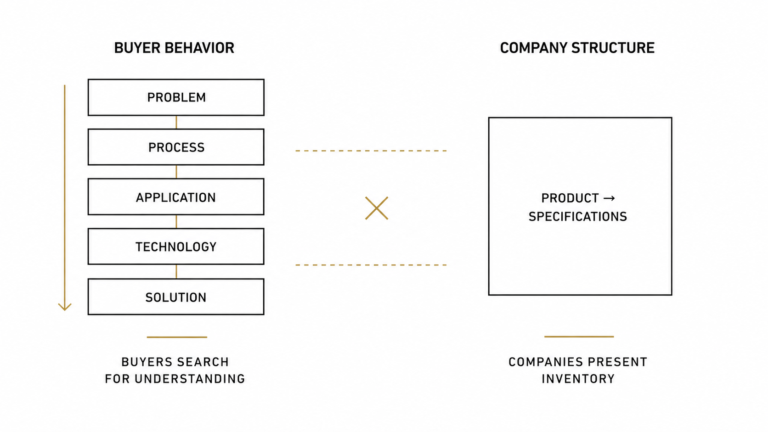
buyers search for understanding, while companies present inventory.
A buyer enters from the problem level:
“how do I automate this process?”
Websites respond from the product level:
model, specifications, codes
The intermediate levels are missing:
- process
- application
- technology
- solution
Correct structure:
process → application → technology → solution → product
Common structure:
product → (nothing else)
The result:
the buyer looks for one thing and finds another.
2. Technical data exists, but cannot be used for comparison
Specifications are present — speed, capacity, dimensions.
But:
- different formats
- different parameters
- no comparative logic
Comparison — a critical decision step — is not supported.
3. Pricing is absent — for valid reasons, with unintended consequences
“Price on request” is the norm.
This is structurally justified:
- customisation
- configuration complexity
- negotiation logic
- margin protection
However:
buyers cannot determine whether a supplier fits their budget before initiating contact.
In early-stage evaluation, this becomes a filter — especially against less-known suppliers.
The solution is not to publish full price lists.
It is to provide orientation:
- indicative ranges
- “starting from” thresholds
- entry vs advanced configurations
This allows buyers to pre-qualify — and allows suppliers to receive more relevant enquiries.
4. International presence is declared, but not operational
Most companies state they export worldwide.
But lack:
- local contacts
- distributor mapping
- service visibility
Information asymmetry favours competitors who reduce uncertainty.
The Diagnosis in Three Dimensions
Across all analysed companies, a consistent pattern emerges:
Technical content: generally strong. Machines are documented, specifications exist.
Buyer discovery: weak. Pages do not answer how buyers search, compare and evaluate.
Commercial guidance: almost absent. There is no structure guiding the buyer toward a qualified decision or contact.
Knowing Your Buyer Journey First Creates a Structural Advantage
In a market where almost no one has mapped how buyers search, compare and decide, the first company that does gains a disproportionate advantage.
This is not about technology. It is not about marketing volume.
It is about understanding how decisions are made before contact.
The first company that structures its information around this process does not just become more visible.
It becomes the default option in early-stage evaluation.
And in B2B markets, the supplier chosen before first contact often wins the deal.
The Question Worth Asking
The pattern described is not specific to one sector.
It is structural across industrial manufacturing:
- strong products
- global ambition
- low discoverability
Not because of lack of quality.
But because information is structured for those who already know the company — not for those trying to find it.
The free PADOS assessment analyses how your product information performs within real buyer search processes:
- what gets found
- what gets ignored
- where decisions break
30 minutes. No commitment.
Research conducted on a sample of specialised industrial machinery manufacturers — Italian, European and international companies. Sources: company websites, registries, export data, trade fair profiles.